Cycles, Timing, and the Discipline of Symbolic Alignment
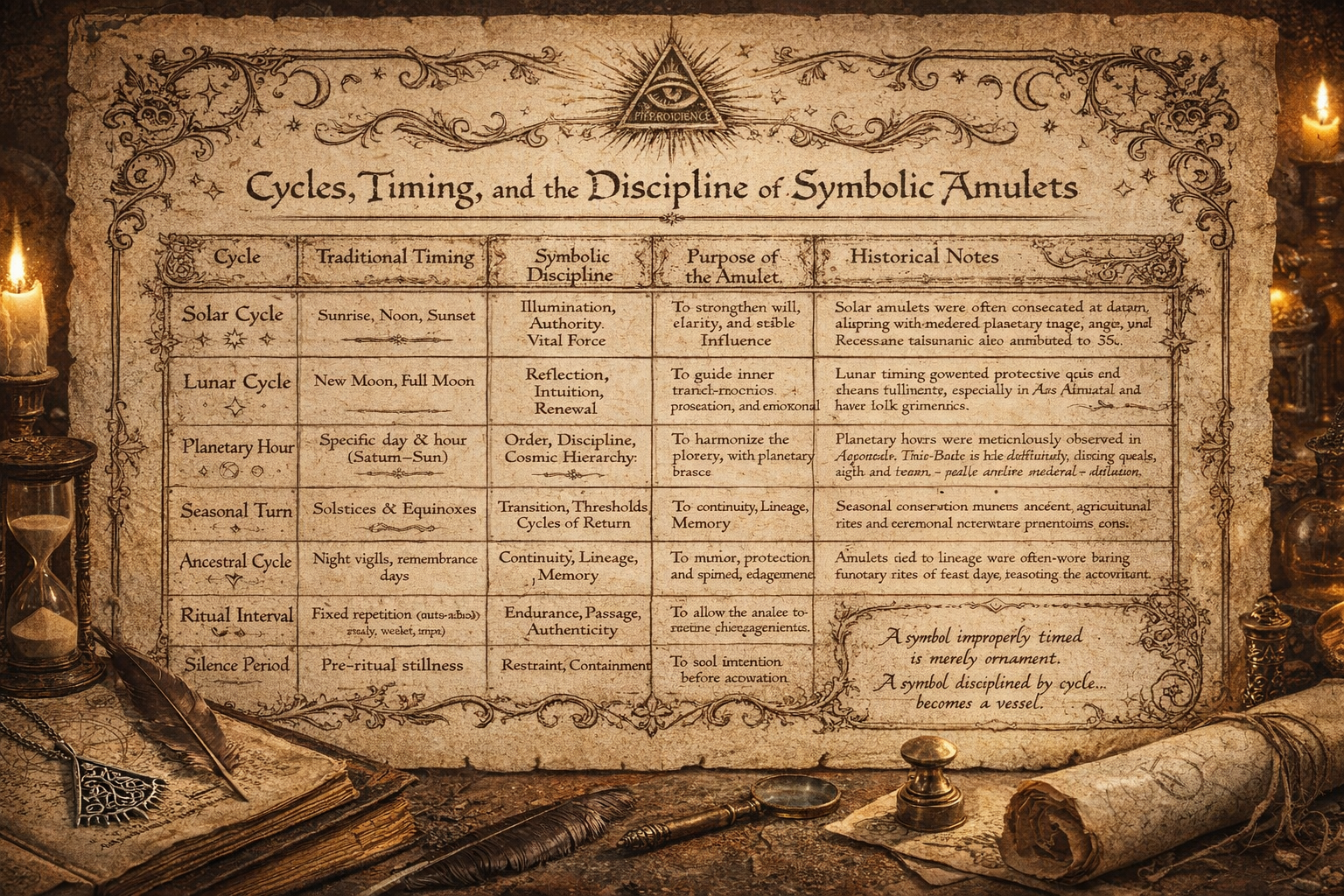
Within historical esoteric traditions, timing mattered—but not in the modern sense of prediction or outcome. Seasons, planetary hours, and lunar phases were understood as symbolic conditions: frameworks through which meaning could be contemplated, refined, and re-encountered.
Sigils were not altered by the seasons. The reader was.
This journal entry examines how seasonal cycles shaped the interpretation of symbols—not as forecasts or instructions, but as reflective structures embedded in time.
Cycles as Framework, Not Fate
Medieval and Renaissance cosmologies viewed time as cyclical rather than linear. The return of seasons affirmed continuity, balance, and decay as necessary counterparts.
Sigils, when situated within these cycles, were not believed to “activate” differently. Instead, their meanings were contemplated through the lens of change—growth in spring, intensity in summer, contraction in autumn, stillness in winter.
Seasonal interpretation did not redefine the symbol. It re-oriented the observer.
Planetary Associations and Temporal Awareness
Planetary correspondences provided an additional layer of symbolic context. Days and hours were associated with philosophical qualities—discipline, reflection, expansion, restraint.
Rather than functioning as astrological determinism, these associations offered rhythm. They structured attention.
In this framework, a sigil aligned with a given planetary quality invited contemplation of that aspect—not invocation, and not promise.
The Role of the Lunar Cycle
The moon’s phases served as a visible measure of impermanence. Waxing, fullness, waning, and absence formed a natural meditation on emergence and dissolution.
Historically, sigils were sometimes revisited—never rewritten—at different lunar moments. The symbol remained constant; interpretation deepened.
This practice emphasized patience and return. Meaning was allowed to unfold gradually rather than be seized.
Seasonal Transition as Moment of Reflection
Equinoxes and solstices marked thresholds rather than endpoints. They were pauses within motion—moments where balance or extremity invited awareness.
Seasonal sigil interpretation at these points focused on reassessment: What has endured? What has shifted? What remains unresolved?
The sigil functioned as anchor, not oracle.
Restraint Over Revelation
The Ars Sacra Journal does not provide seasonal prescriptions or interpretive formulas. Historically, excessive fixation on timing was viewed as distraction rather than insight.
Seasonal alignment was meant to cultivate attentiveness—not dependency.
By framing sigils within cycles of time, Ars Sacra preserves the tradition of restraint: symbols are encountered repeatedly, not consumed once.
Returning to the Mark
A sigil does not change with the season.
The season changes the way it is seen.
Seasonal interpretation invites return—quietly, without urgency. It affirms that meaning is not exhausted through use, but refined through repetition.
Time does not unlock the symbol.
It reveals the reader.